
Share this with your friends & families
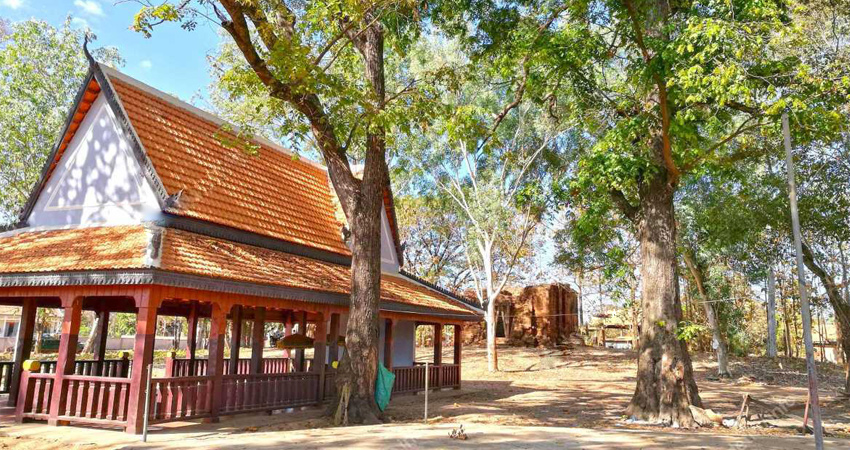
Preah Ko was the first temple to be built in the ancient and now defunct city of Hariharalaya (in the area that today is called Roluos), some 15 kilometers south-east of the main group of temples at Angkor, Cambodia. The temple was built under the Khmer King Indravarman I in 879 to honor members of the king's family, whom it places in relation with the Hindu deity Shiva.
After the Khmer king Jayavarman II founded the Khmer empire in 802 A.D., he finally established his capital at Hariharalaya. Indravarman I was the nephew of Jayavarman II. When he ascended to the throne, he ordered the construction first of Preah Ko, which was dedicated in 879, and later of the temple-mountain known as the Bakong. It is likely that this building program was made possible by the king's peaceful reign and his ability to draw income from the expanding empire. A restoration of the towers took place in early 1990s, financed by German government.
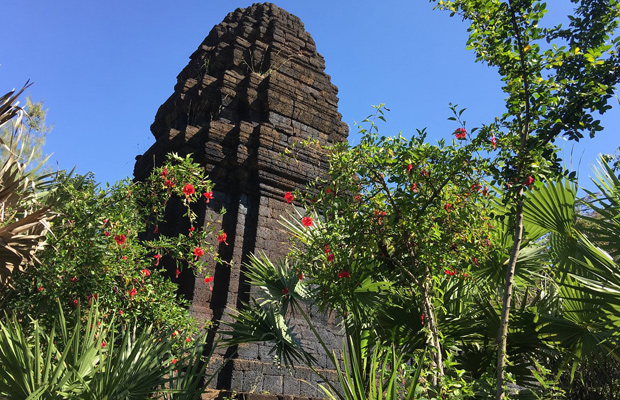
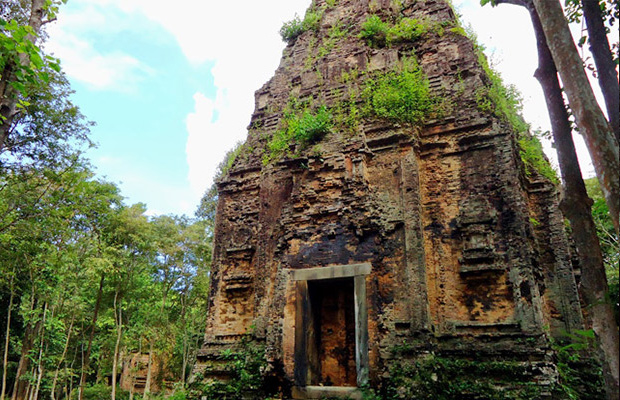
Preah Ko consists of six brick towers arranged in two rows of three towers each perched on a sandstone platform. The towers face east, and the front central tower is the tallest. The sanctuaries are dedicated to three divinized forefathers of Indravarman and their respective wives. The front central tower is dedicated to Jayavarman II, the founder of the Khmer empire.[1] The tower to the left is dedicated to Prithivindreshvara, King Indravarman's father; the tower to the right to Rudreshvara, his grandfather. The three rear towers are dedicated to the wives of these three men.The central towers all bear images of the Hindu god Shiva.
Preah Ko, which means 'the sacred bull' (Shiva's vehicle Nandi), was built by Indravarman I in 879. It is part of the Roluos group of monuments about 13 kilometers east of Siem Riep. The temple is distinguished from others in the area by the unusual arrangement of its six central towers, which stand in two rows facing east.
The three towers on the east side are staggered so that the central tower is slightly further to the west. This tower is dedicated to Shiva, the Hindu god closely associated with the rule of Jayavarman II, the founder of the Khmer Empire. The tower to the north was dedicated to the founder of Preah Ko, and the tower to the south was dedicated to the King's father. Each of these shrines once contained a statue, but they were removed at some time in the past.
- North Eastern Cambodia
- 1Day
Preah Ko was the first temple to be built in the ancient and now defunct city of Hariharalaya (in the area that today is called Roluos), some 15 kilometers south-east of the main group of temples at Angkor, Cambodia. The temple was built under the Khmer King Indravarman I in 879 to honor members of the king's family, whom it places in relation with the Hindu deity Shiva.
Other Travelstyle
- Small Group Tours (Siem Reap, Phnom Penh, Sihanoukville)
- Private Day Tours (Siem Reap, Phnom Penh, Sihanoukville)
- Multi-Day Tours
- Angkor National Park Tickets
- Transports and Transfer
- Angkor Excursions
- Siem Reap to Phnom Penh
- Battambang Excursions
- Phnom Penh Excursions
- From Phnom Penh
- Cambodia Tickets