
Share this with your friends & families
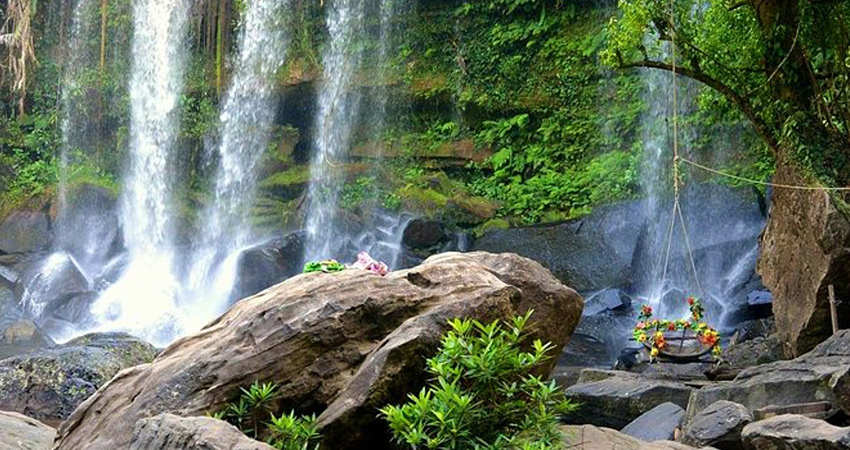
The Phnom Kulen mountain range is located 30 km northwards from Angkor Wat. Its name means "mountain of the Lychee” . There is a sacred hilltop site on top of the range.
Phnom Kulen is considered a holy mountain in Cambodia, of special religious significance to Hindus and Buddhists who come to the mountain in pilgrimage.
It also has a major symbolic importance for Cambodians as the birthplace of the ancient Khmer Empire, for it was at Phnom Kulen that King Jayavarma II proclaimed independence from Java in 804 CE. Jayavarman II initiated the cult of the king, a linga cult, in what is dated as 804 CE and declaring his independence from Java of whom the Khmer had been a vassalage state (whether this is actually "Java" or "Lava" (a Lao kingdom) is debated, as well as the legend that he was earlier held as a ransom of the kingdom in Java. See Higham's The Civilization of Angkor for more information about the debate). During the Angkorian era the relief was known as Mahendraparvata (the mountain of Great Indra).
- Siem Reap
- 1Day
The Phnom Kulen mountain range is located 30 km northwards from Angkor Wat. Its name means "mountain of the Lychee” . There is a sacred hilltop site on top of the range.
Other Travelstyle
- Small Group Tours (Siem Reap, Phnom Penh, Sihanoukville)
- Private Day Tours (Siem Reap, Phnom Penh, Sihanoukville)
- Multi-Day Tours
- Angkor National Park Tickets
- Transports and Transfer
- Angkor Excursions
- Siem Reap to Phnom Penh
- Battambang Excursions
- Phnom Penh Excursions
- From Phnom Penh
- Cambodia Tickets
Siem Reap Hotels
Siem Reap Tours
- Angkor With Your Heart 7Days-6Nights
- An Introduction to the Khmer culture tour 1Day
- Kulen Elephant Forest and Tonle Sap Lake From Siem Reap
- Siem Reap Phare Circus Show
- The river of 1000 Lingas and the Citadel of the Women tour 1Day
- Angkor Wat and Banteay Srei Private Day Tour From Siem Reap
- Sambor Prei Kuk tour 1Day
- Tonle Sap Lake-Floating Villages-Mangrove Forest from Siem Reap
- 1-Day Angkor Wat Admission Ticket With Tuk Tuk
- The Complete Khmer Odyssey 14Days-13Nights
- Siem Reap Angkor Airport Arrival Fast Track Service
- Kulen Waterfall National Park Ticket